Sources
Sources and picture credits
The pages of this site carry no source notes; they are all here, in one place. If you spot a mistake, write to [email protected].
Each page’s sources
Tap a name for its full entry in the list below.
- HomeCharitamrit, Vrajotsava Chandrika, Vraja Bhakti Vilasa, Shri Bhaktamal, Priyadas, 1712, Growse, 1883, Braj aur Braj Yatra, 1959, Hein, 1972, Entwistle, 1987, Temple website, Amar Ujala, 2023, Dainik Jagran, 2026, Vrindavan Today, 2026
- Shri Ladli JiCharitamrit, Laghu Charitamrit, Vrajotsava Chandrika, Growse, 1883, Mital, 1962, Mital, 1966, Mital, 1968, Snatak, 1957, Bhaktakosh, 1989, Hein, 1972, Entwistle, 1987, Braj ki Jhanki, Temple website, Amar Ujala, 2021, Amar Ujala, 2023, Amar Ujala, 2025, Dainik Jagran, 2018, Dainik Jagran, 2026, Dainik Bhaskar, 2024, Vrindavan Today, 2026, Vrindavan Today, Vivek Dutt, newspaper article, English Wikipedia
- His lifeCharitamrit, Laghu Charitamrit, Vrajotsava Chandrika, Vraja Bhakti Vilasa, Shri Bhaktamal, Priyadas, 1712, Pratap Singh, 1866, Growse, 1883, Mital, 1966, Mital, 1968, Braj aur Braj Yatra, 1959, Ras Lila: Ek Parichay, 1959, Hein, 1972, Entwistle, 1987, Amar Ujala, 2023, Dainik Jagran, 2018, Vrindavan Today, Braj Breaking, 2025, Braj Breaking, Dauji 2025, History Pandit, Hindi Wikipedia, ISKCON (Unchagaon), ISKCON (Lalita Sakhi)
- BrajCharitamrit, Vrajotsava Chandrika, Vraja Bhakti Vilasa, Shri Bhaktamal, Priyadas, 1712, Growse, 1883, Mital, 1966, Ras Lila: Ek Parichay, 1959, Hein, 1972, Entwistle, 1987, Temple website, Dainik Jagran, 2026, Hindustan, 2026, Braj Breaking, 2025, Braj Breaking, Dauji 2025, Braj Breaking, Lalita 2025, Braj Breaking, parikrama 2025, History Pandit
- GranthsCharitamrit, Laghu Charitamrit, Vrajotsava Chandrika, Vraja Bhakti Vilasa, Growse, 1883, Hein, 1972, Entwistle, 1987
- His lineCharitamrit, Vrajotsava Chandrika, Mital, 1962, Mital, 1966, Amar Ujala, 2023, Amar Ujala, 2025, Hindustan, 2026, Prabhat Khabar, 2023, Vrindavan Today, 2026, Vrindavan Today, 2023, Braj Breaking, 2025, Braj Breaking, 2024, Braj Breaking, Dauji 2025, Braj Breaking, Lalita 2025, Braj Breaking, parikrama 2025, Braj Breaking, Holi 2024
- VisitCharitamrit, Vrajotsava Chandrika, Priyadas, 1712, Braj aur Braj Yatra, 1959, Entwistle, 1987, Hindustan, 2026, Braj Breaking, 2025, Braj Breaking, Lalita 2025, History Pandit, ISKCON (Unchagaon)
- MediaCharitamrit, Vrajotsava Chandrika, Vraja Bhakti Vilasa, Priyadas, 1712, Growse, 1883, Mital, 1966, Mital, 1968, Snatak, 1957, Hein, 1972, Entwistle, 1987, Temple website, Vrindavan Today, 2026
Who said what
The site’s main points, and the sources they rest on.
| Point | Source |
|---|---|
| The story of Shri Ladli Ji, the name Ladili-Lal, the seva given to Narayandas, the title Brajacharya, Vaman Dwadashi | Charitamrit |
| Birthplace Pushkali on the Godavari; Krishna’s call at twelve; five years at Radha Kund; Baldev’s first abhishek, 1555; the Radhashtami rite before dawn | Vrajotsava Chandrika, Laghu Charitamrit |
| 137 forests and 16 banyans; two pilgrimages; finished at Radha Kund in Samvat 1609 | Vraja Bhakti Vilasa |
| He revealed the hidden places of the Mathura mandal named in the Varaha Purana | Shri Bhaktamal |
| His guru Krishnadas Brahmachari; the ras in place after place; the Triveni springs | Priyadas, 1712 |
| Every lake and grove of Braj named by him; he first established the ban yatra; his father’s name in the old manuscript | Growse, 1883 |
| The forest yatra the oldest itinerary of Braj; Vraja Bhakti Vilasa the fullest work; the length of the Govardhan parikrama | Entwistle, 1987 |
| The great sixteenth century organiser of the ras; the form itself is older | Hein, 1972, Mital, 1966, Ras Lila: Ek Parichay, 1959 |
| The year Samvat 1626 (1569); Narayandas first served in a hut; ‘Shri Ladililal ki jai’ at the ras; the Budhi Lila on the Premankura Nataka | Snatak, 1957, Mital, 1966 |
| The oldest temple by Raja Bir Singh Deo, founded January 1619; Brajoddharak; Damodar born Samvat 1614; Narayandas’s pada | Mital, 1966, Mital, 1968, Mital, 1962 |
| The temple is the fifth; earlier ones by Lakha Banjara and Raja Todar Mal; the festival on Ashadh Shukla 2 | Temple website |
| The place of tapas and bhajan on the hill is Narayandas’s | Braj ki Jhanki, Amar Ujala, 2021 |
| Father at heart; the family’s daughter bond; daughters’ names in Barsana | Amar Ujala, 2023, Dainik Jagran, 2018, Vrindavan Today, Dainik Bhaskar, 2024 |
| The Radhashtami 2026 rites before dawn, and their order | Vrindavan Today, 2026, Dainik Jagran, 2026, Amar Ujala, 2025 |
| In 2023 a temple pujari called the Bhatts the guru family | Prabhat Khabar, 2023 |
| Ladle Thakur in the Dauji temple | History Pandit |
| Maharaj Ji’s festivals: the jayanti, Lalita’s birth festival, Nag Panchami, the Ashta Sakhi parikrama, Holi | Braj Breaking, 2025, Braj Breaking, 2024, Braj Breaking, Lalita 2025, Braj Breaking, Dauji 2025, Braj Breaking, parikrama 2025, Braj Breaking, Holi 2024 |
Where the sources differ
We do not hide these. We will keep settling them with the family and with scholars.
Shri Ladli Ji
- The year
- Samvat 1626, Ashadh Shukla 2, that is 1569 (Baba Krishnadas from 1949; Mital; the temple’s festival). The year is not in the Charitamrit’s verses, as Mital noted in 1966; Hein (1972) also gives 1569. Samvat 1602, 1604 and 1606 are also printed, as are round figures like ‘450 to 600 years ago’. A rite in his Vrajotsava Chandrika dated Samvat 1612 (1555) already speaks of the pair in the hill temple.
- Other tellings
- Charitamrit: a vision, then the finding on the hill after midnight. Laghu Charitamrit: the guru gave the murti to his Barsana disciple. Amar Ujala (2021): a sign in a dream, and he brought Her out with his disciple. Gita Press’s Braj ki Jhanki: Ladli Ji told Narayandas in a dream that She lay beneath his bhajan seat, and he dug Her out.
- The pair, or Radha alone
- The Charitamrit, the Vrajotsava Chandrika and the temple: Ladili-Lal, the pair. The Laghu Charitamrit and most news reports: Radha alone.
- The name
- The Charitamrit credits the Bhatt with naming the pair, but explains ‘Ladili’ by Her parents’ love, and Krishna had already used the name at the Godavari. The Vrajotsava Chandrika calls it Brahma’s boon. Growse (1883) calls Ladli a local title of Radha meaning ‘the beloved’.
- The oldest temple
- Raja Bir Singh Deo, Samvat 1675 (Mital; Entwistle says ‘attributed’). English Wikipedia’s ‘1675 AD’ looks like the same Samvat year read as CE.
- Narayandas’s dates
- Charitamrit: a disciple at eighty. Mital (1962): roughly Samvat 1600 to 1700. The Bhaktakosh (1989) reads the years differently.
- Tapasya on the hill
- The Charitamrit describes his sadhana on the hill as wandering it in gopi-bhava, and names no seat, cave or vow; no old text gives a separate account of a tapasya on Brahmanchal. The place of tapas and bhajan shown on the hill today is that of his disciple Narayandas, Swami ji (Braj ki Jhanki; Amar Ujala 2021).
- Father at heart, and the daughter bond
- Amar Ujala (2023) calls him Radha Rani’s father at heart and says he named Her Ladli out of that love; Vrindavan Today writes that he worshipped Her as his daughter. No old text writes this bond down; it is the family’s living memory.
- The name Lado
- A newspaper article by the Mathura journalist Vivek Dutt says he also gave Radha the name Lado. The paper and date are not yet known; no old text says so.
- The Radhashtami 2026 rites
- Vrindavan Today: Goswami Shri Krishnanand Bhatt Ji Maharaj performed them. Dainik Jagran: the abhishek began in the presence of Acharya Susat Maharaj. Amar Ujala names Susath Maharaj and Shri Krishnanand Bhatt Ji as the same man.
His life
- His birth day
- Vaishakh Shukla 14, Narasimha Chaturdashi (the Charitamrit; the jayanti today), or the Vaishakh full moon (Vrajotsava Chandrika). The two may be only hours apart.
- Birthplace
- Pushkali, or Mathura-pattana, on the Godavari (Vrajotsava Chandrika; Laghu Charitamrit); Madura or Madurai (Baba Krishnadas from 1947, Mital, Hein, the temple website); Unchagaon (Pratap Singh, 1866 to 1872, probably meaning the family seat). This site, like many books, used to say Madurai; that reading came from twentieth century editors.
- Years at Radha Kund
- Five (Vrajotsava Chandrika; Entwistle); seven (Amar Ujala 2023; Vrindavan Today); about twelve (Mital 1968; Hindi Wikipedia); sixteen (Dainik Jagran 2018).
- His guru
- Krishnadas Brahmachari (Priyadas 1712; the Charitamrit). Gaudiya texts make him a disciple of Gadadhar Pandit; some writers, of Sanatan Goswami.
- Credit for the ras
- The ras is older than him (Hein, Mital, Agrawal). The Nimbarka tradition credits Ghamand Dev. Baba Krishnadas (1949) and Growse make him its founder; scholars, its great sixteenth century organiser.
- The year he left his body
- About Samvat 1700 (1643), which comes from a prophecy in his Vrajotsava Chandrika and would make him 112 (Baba Krishnadas; Mital). The Charitamrit, the Laghu Charitamrit, Hein and Entwistle give no year.
- Same name, other people
- Melpathur Narayana Bhattathiri of Kerala (Narayaneeyam) and Narayan Bhatt of Kashi are different people. Entwistle notes that Todar Mal helped the Kashi Narayan Bhatt in 1585.
- Lalita’s birthplace
- The Charitamrit: Sakhi Giri at Unchagaon. Gaudiya writers: Karhala.
- Ladle Thakur today
- By History Pandit, the Dauji temple at Unchagaon. Baba Krishnadas (1961): the Ladileya came back to Uchchagram from Neemrana.
Braj and his line
- Places: recovered, or newly placed
- The family texts hold every site to be recovered. Entwistle (1987) holds that many were newly placed at the time, that most of the Puranas Vraja Bhakti Vilasa credits its verses to look like later attributions, and that many of its forests cannot be found today.
- Sanket
- The seventeenth century poet Dhruvdas wrote that he revealed Sanket (Mital 1966).
- Radharaman ji
- The Charitamrit: at Sanket, at Radharaman ji’s request, the Rasa Panchadhyayi and the Rasikahladini. Tying Radharaman ji’s prakatya to him as well is found only in Braj Breaking.
- The kanthi diksha
- That Barsana’s sevayat Goswamis take kanthi diksha from the Bhatt line is found only in Vrindavan Today (2026). The family speaks of the diksha bond too, and Ladilidas’s old mangal praises him for giving kanthi.
All sources
His own works, and the family’s texts
- Goswami Janakiprasad Bhatt, Shri Narayan Bhatt Charitamrit (Sanskrit, about 1700), ed. Baba Krishnadas, Samvat 2013 (1957)
- Laghu Shri Narayan Bhatt Charitamrit, by an unnamed follower (from a Neemrana copy of Samvat 1928), ed. Baba Krishnadas, Samvat 2020
- Shri Narayan Bhatt Ji, Vrajotsava Chandrika (rites dated Samvat 1612), ed. Baba Krishnadas, Samvat 2017 (1961)
- Shri Narayan Bhatt Ji, Vraja Bhakti Vilasa (Samvat 1609), ed. Baba Krishnadas, Samvat 2008 (1952)
Old witnesses
- Nabhadas, Shri Bhaktamal, chhappay 87 and 88, around 1600 (text at sanskritdocuments.org)
- Priyadas, Bhaktirasabodhini (1712), in Shri Bhaktamal with Rupkala's commentary, 1951 printing
- Pratap Singh, Bhaktmal arthat Bhaktakalpadrum, 1866 to 1872 (1926 printing)
- F. S. Growse, Mathura: A District Memoir, third edition, 1883
Scholarship
- Prabhudayal Mital, Chaitanya Mat aur Braj Sahitya, 1962
- Prabhudayal Mital, Braj ka Sanskritik Itihas, 1966
- Prabhudayal Mital, Braj ke Dharma Sampradayon ka Itihas, 1968
- Vijayendra Snatak, Radhavallabh Sampraday: Siddhant aur Sahitya, 1957 (p.280 quotes Baba Krishnadas's booklet of 1949)
- Govind Das and Ram Narayan Agrawal (eds), Braj aur Braj Yatra, 1959
- Govind Das and Ram Narayan Agrawal (eds), Ras Lila: Ek Parichay, 1959
- Bhagwati Prasad Singh and Basudeo Singh, Radhakrishna Bhaktakosh, vol. 4, 1989
- Norvin Hein, The Miracle Plays of Mathura, Yale University Press, 1972
- A. W. Entwistle, Braj: Centre of Krishna Pilgrimage, 1987
- Chhedilal Kansyakar, The Boodhi-lila of Braj, Sangeet Natak, Vol. 39 No. 2, 2005
- Goswami Lakshmanacharya, Braj ki Jhanki, Gita Press, Gorakhpur (undated)
News and websites
- Mandir Shri Ladlee Ji Maharaj, Barsana: About Temple (read 15 Oct 2026)
- Amar Ujala: Radhashtami and the Barsana temple, 12 Sep 2021
- Amar Ujala, Mathura: 'Narayan Bhatt gave Radharani the name Ladli', 22 Sep 2023
- Amar Ujala: the two-day Ashta Sakhi village parikrama, 5 Nov 2025
- Dainik Jagran, Mathura: 'This family still regards Radha as a daughter', 16 Sep 2018
- Dainik Jagran: Radhashtami at Barsana, 19 Sep 2026
- Dainik Bhaskar, Mathura: Barsana daughters named after Radha Rani, 9 Sep 2024
- Hindustan, Mathura: Lalita ji's wedding with Shri Krishna, 23 Sep 2026
- Prabhat Khabar: Radhashtami preparations in Barsana, Sep 2023
- Vrindavan Today, Jagannath Poddar: Through the Bhatt Lineage, an Ancient Radhashtami Tradition Lives On, 19 Sep 2026
- Vrindavan Today: Grand Celebration of Radha Rani's Birth Anniversary in Braj, 23 Sep 2023
- Vrindavan Today: Barsana's Ladli ji, the Cherishing Daughter of Goswami Shri Narayan Bhatt (undated)
- Braj Breaking: report on the jayanti, 12 May 2025
- Braj Breaking: notice of the jayanti, 9 May 2025
- Braj Breaking: the jayanti of Narayan Bhatt, 22 May 2024
- Braj Breaking: Dauji's prakatya festival at Unchagaon and Nandgaon, 30 Jul 2025
- Braj Breaking: Lalita janmotsav at Unchagaon, 29 Aug 2025
- Braj Breaking: the Ashta Sakhi parikrama with Ladle Thakur, 30 Oct 2025
- Braj Breaking: Surabhi Holi at the samadhi, 22 Mar 2024
- Vivek Dutt Mathuriya, History Pandit, 6 May 2020
- Vivek Dutt (Mathura), 'Narayan Bhatt gave Radha the name Lado', newspaper history page
- Hindi Wikipedia: Narayan Bhatt
- English Wikipedia: Radha Rani Temple
- ISKCON Desire Tree: Unchagaon
- ISKCON Desire Tree: Appearance day of Lalita Sakhi
Further reading: Leena Taneja, The Forgotten Story of Narayan Bhatt, Journal of Vaishnava Studies 15(2)
Corrections
After the research of October 2026, these changed on this site:
- Birthplace: this site said Madurai. His own books say Pushkali, on the Godavari.
- Years at Radha Kund: this site said twelve. His Vrajotsava Chandrika says five.
- ‘More than 300 places’: no old source has this figure. Vraja Bhakti Vilasa itself counts 137 forests and 16 banyans.
- The ras lila: this site called him its founder. Scholars hold the form is older, and call him its great organiser.
- The peeth’s name: until the family settles the names and titles of the seats, the site goes by his name.
About the translations
The Sanskrit texts are centuries old and open to all. We do not reprint Baba Krishnadas’s Hindi translations and prefaces; we sum them up in our own words and credit him here. The meanings of the verses on this site are our own.
Picture credits
Narayan Bhatt Ji’s traditional portrait, the murals, the charan paduka and Maharaj Ji’s photo belong to the family, and the samadhi photo to History Pandit; all rights in them stay with their owners. The other photographs come from Wikimedia Commons under the licence shown; we resized them, and the resized versions of CC BY-SA pictures carry the same licence. The old paintings are in the public domain, or their museums have opened them to all (CC0).
 Brahmanchal hill, Barsana
Picture: Kridha20, CC BY-SA 4.0 Shri Ladli Ji's temple at dusk
Picture: Abhijit Kar Gupta, CC BY 2.0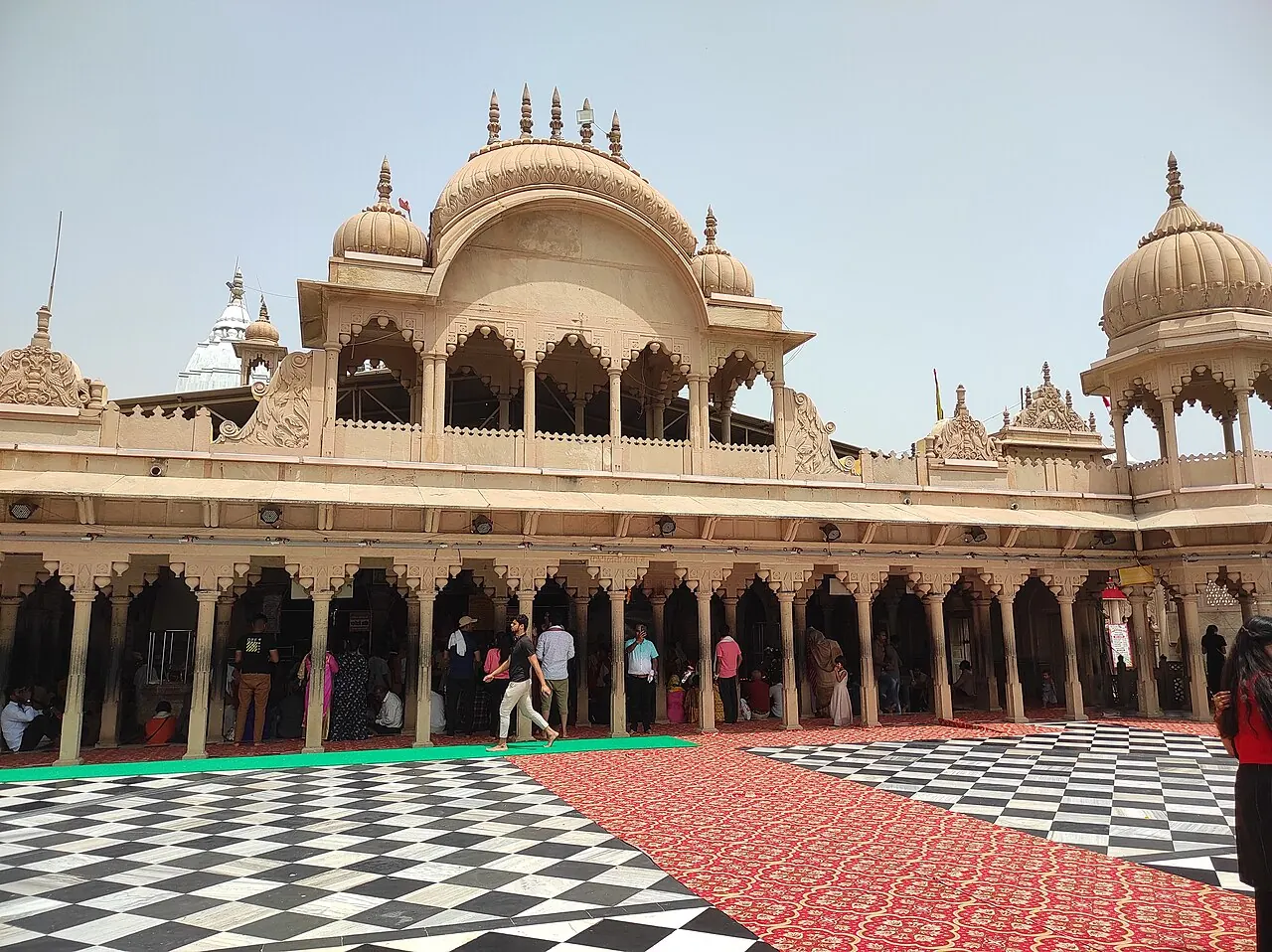 Courtyard of Shri Ladli Ji's temple
Picture: Kridha20, CC BY-SA 4.0 Shri Ladli Ji's temple, the front
Picture: Aliva Sahoo, CC BY-SA 3.0 Steps up to the temple
Picture: GourangaUK, English Wikipedia, CC BY-SA 3.0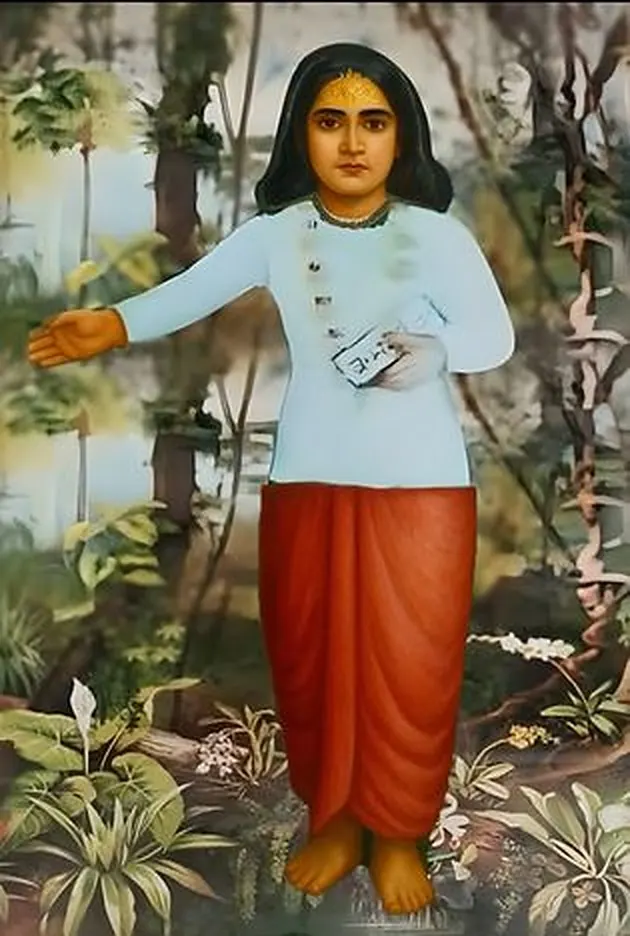 Shril Goswami Narayan Bhatt Ji Maharaj, traditional portrait
Picture: Traditional portrait, kept by the family Mural, with Vraja Bhakti Vilasa in hand
Picture: Mural, kept by the family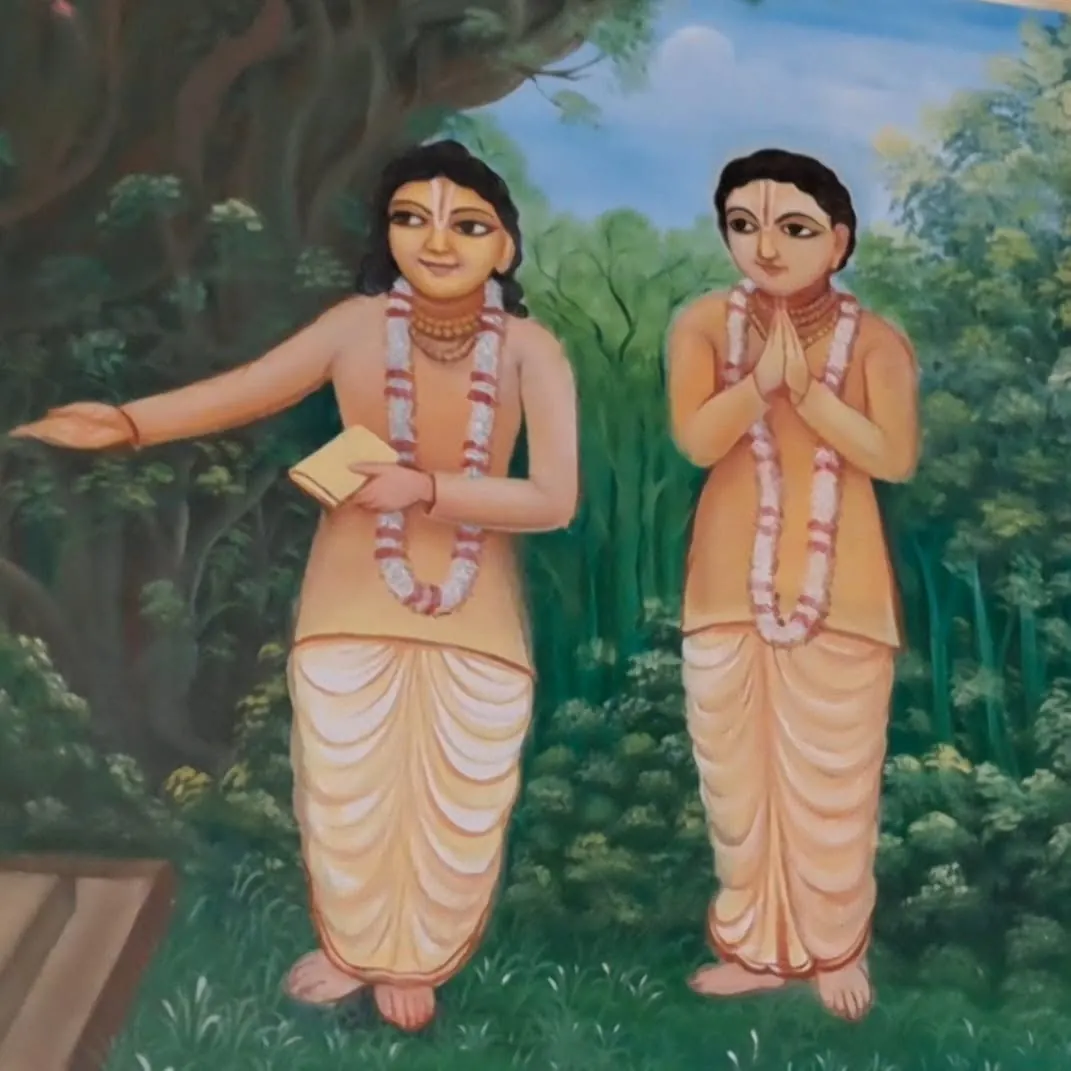 Mural, in the forest
Picture: Mural, kept by the family Shril Narayan Bhatt Ji's charan paduka
Picture: Kept by the family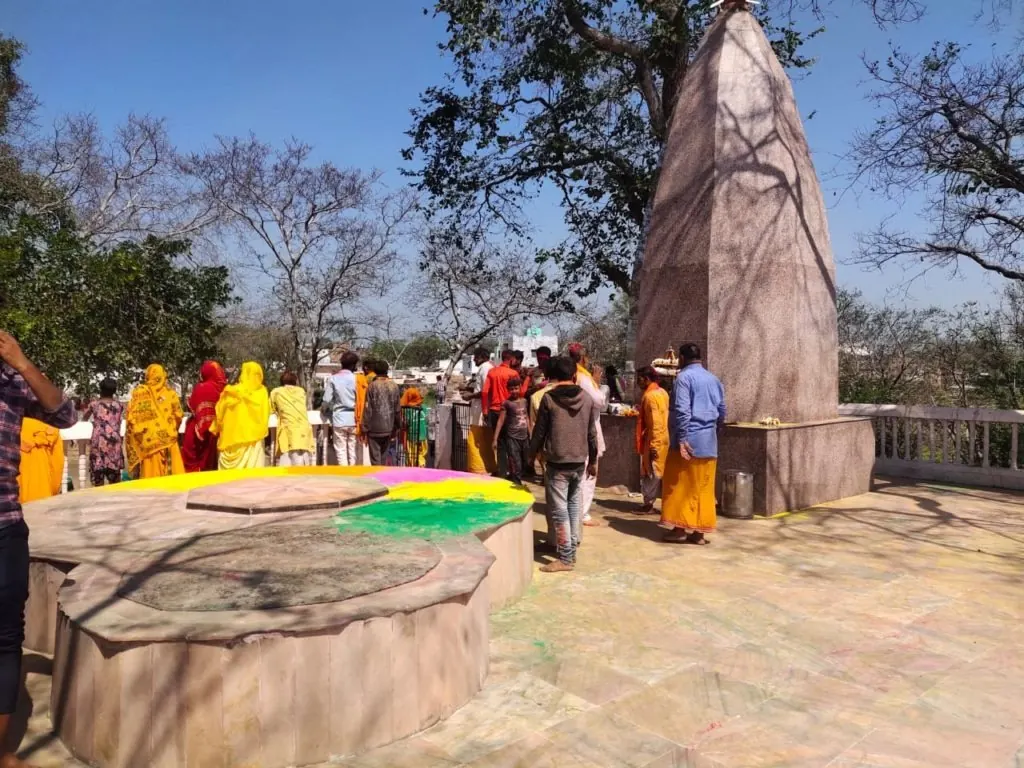 His samadhi, Unchagaon
Picture: History Pandit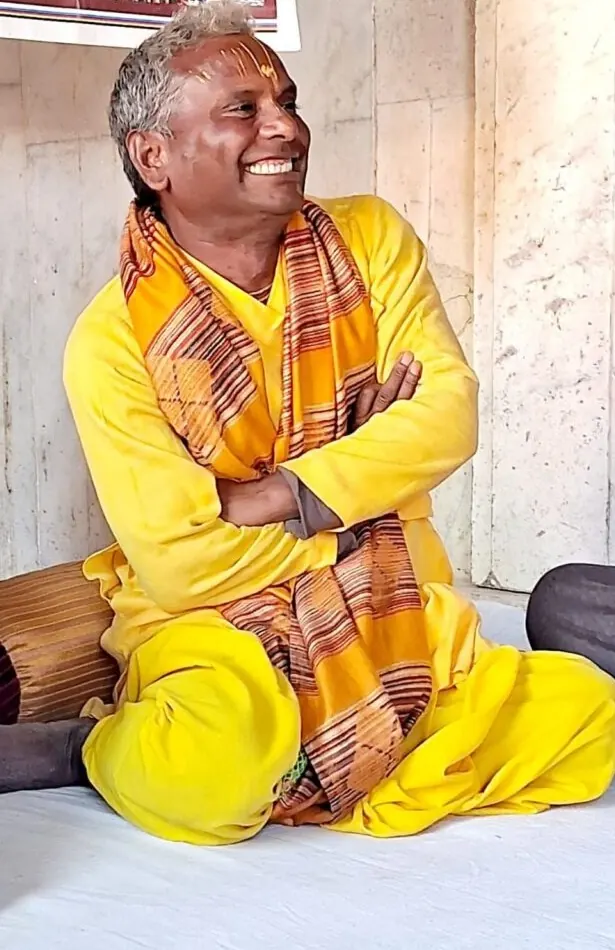 Goswami Shri Krishnanand Bhatt Ji Maharaj
Picture: Kept by the family Radha Kund and Shyam Kund
Picture: Aliva Sahoo, CC BY-SA 3.0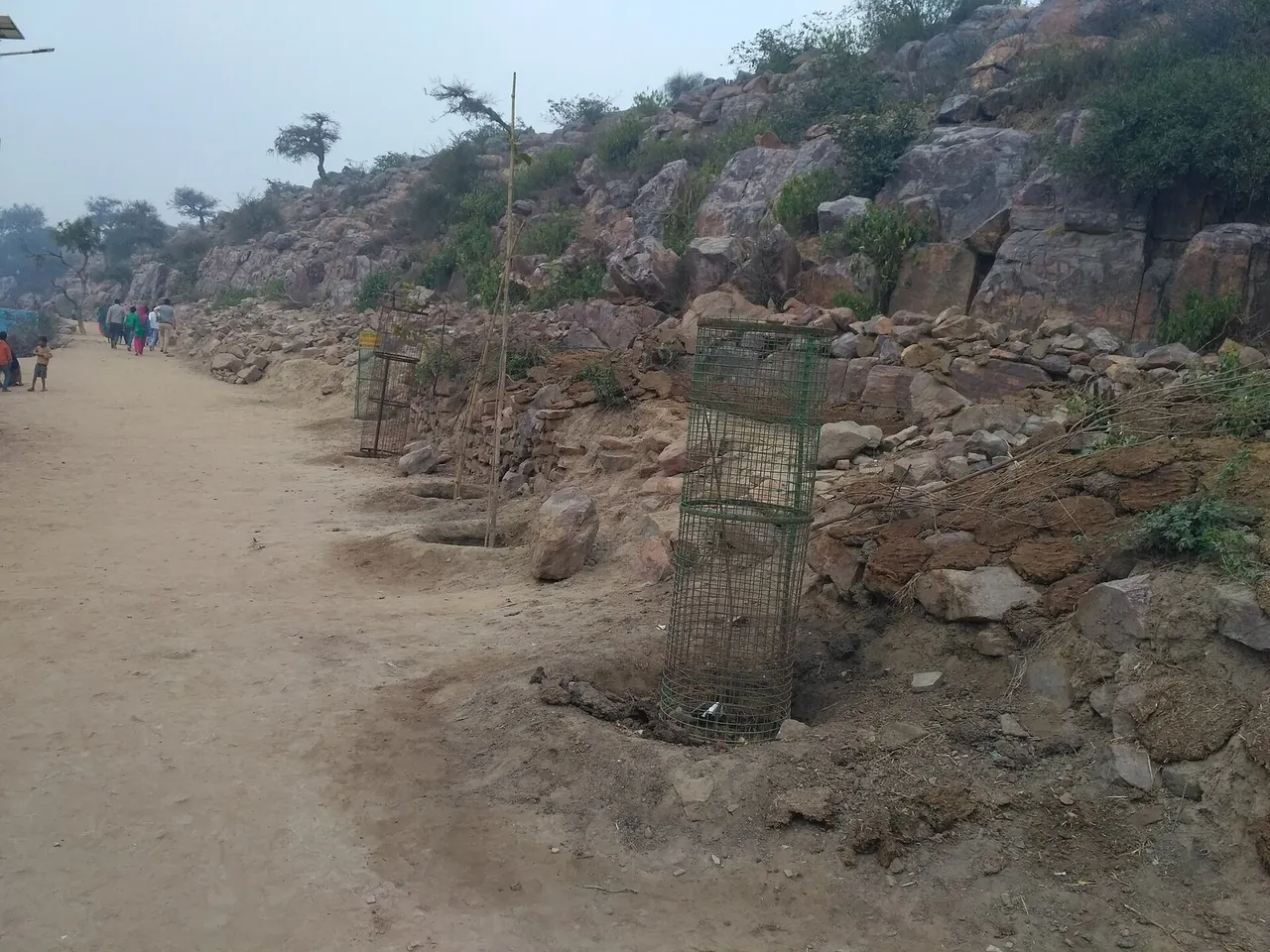 Giriraj and the parikrama path, Jatipura
Picture: Manish kumar ambesh, CC BY-SA 4.0 Kusum Sarovar
Picture: Arjunfotografer, CC BY-SA 4.0 Manasi Ganga, 1883
Picture: Plate in F. S. Growse, Mathura: A District Memoir, 1883, public domain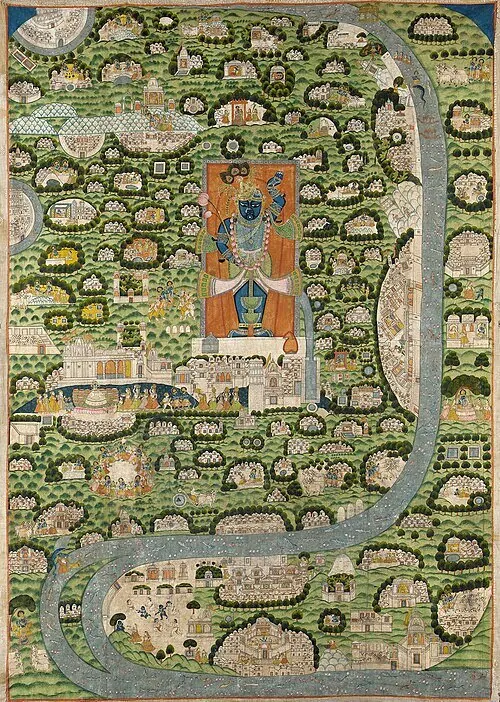 Pichhavai of the Braj parikrama
Picture: Unknown painter, Rajasthan, 19th century, public domain Radha, a Kishangarh painting
Picture: Kishangarh, Rajasthan, about 1750, The Metropolitan Museum of Art, public domain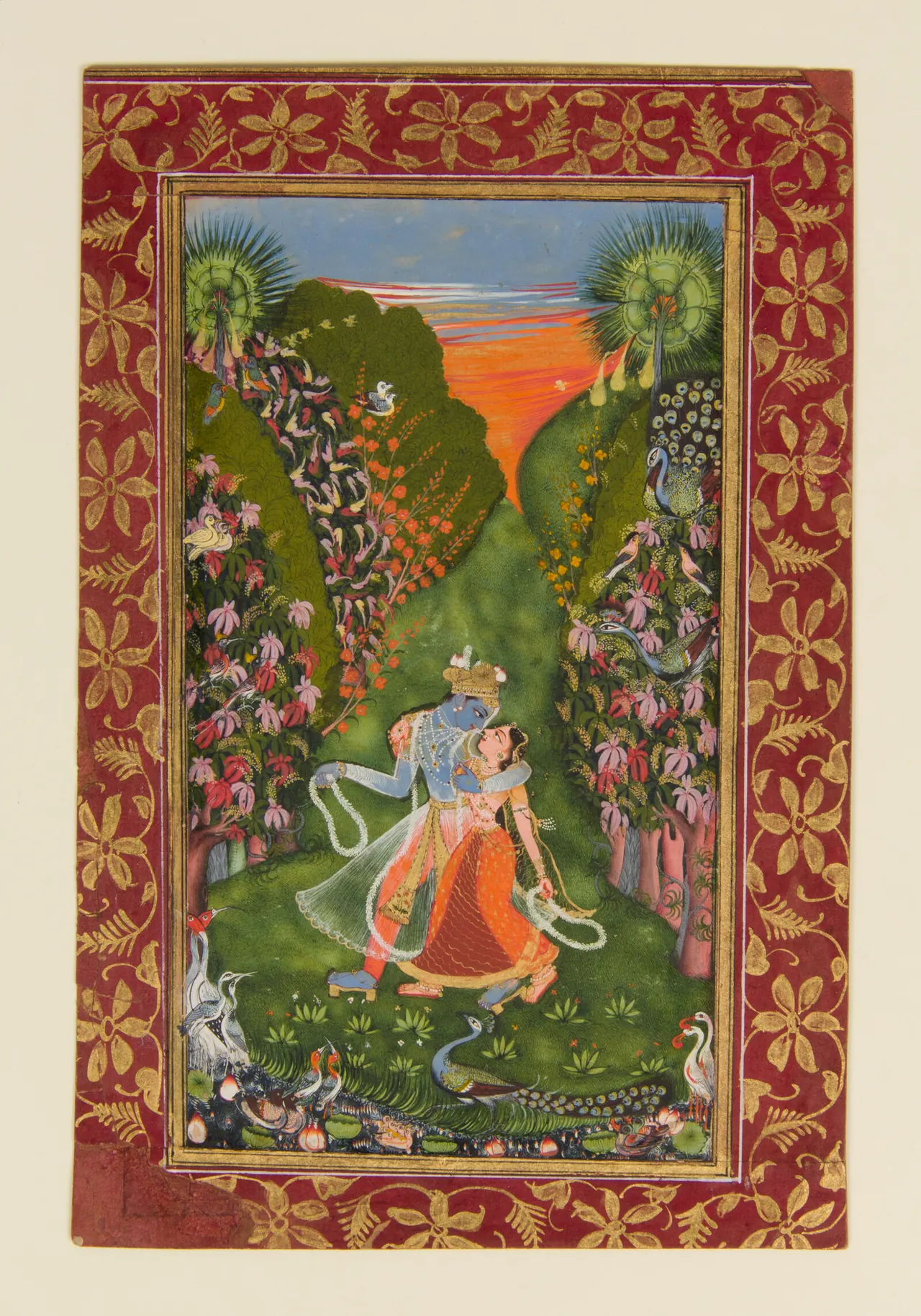 Radha and Krishna in a grove
Picture: The Kota Master, about 1720, The Metropolitan Museum of Art, public domain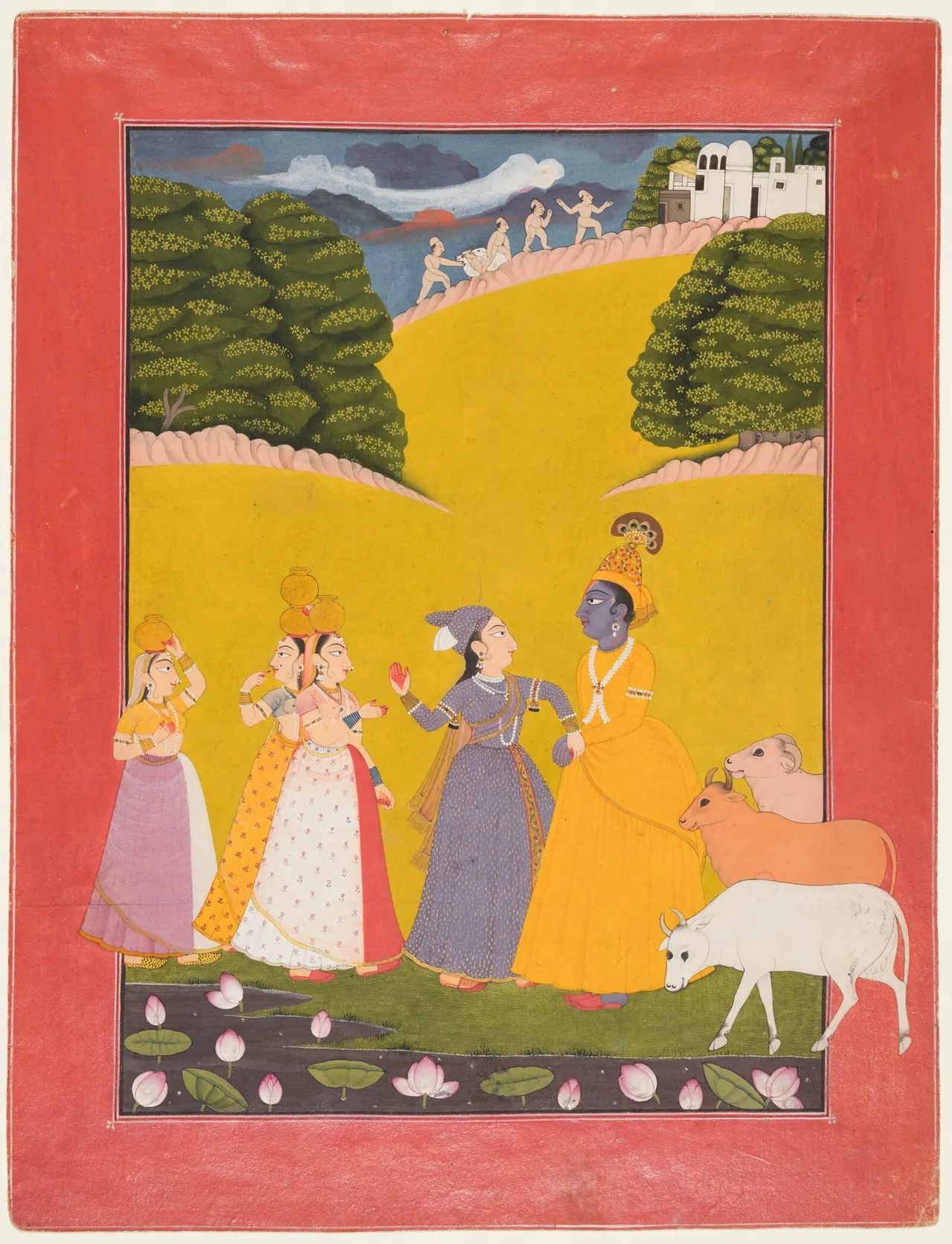 A painting of the dan lila
Picture: Pahari painter, about 1760, Cleveland Museum of Art, CC0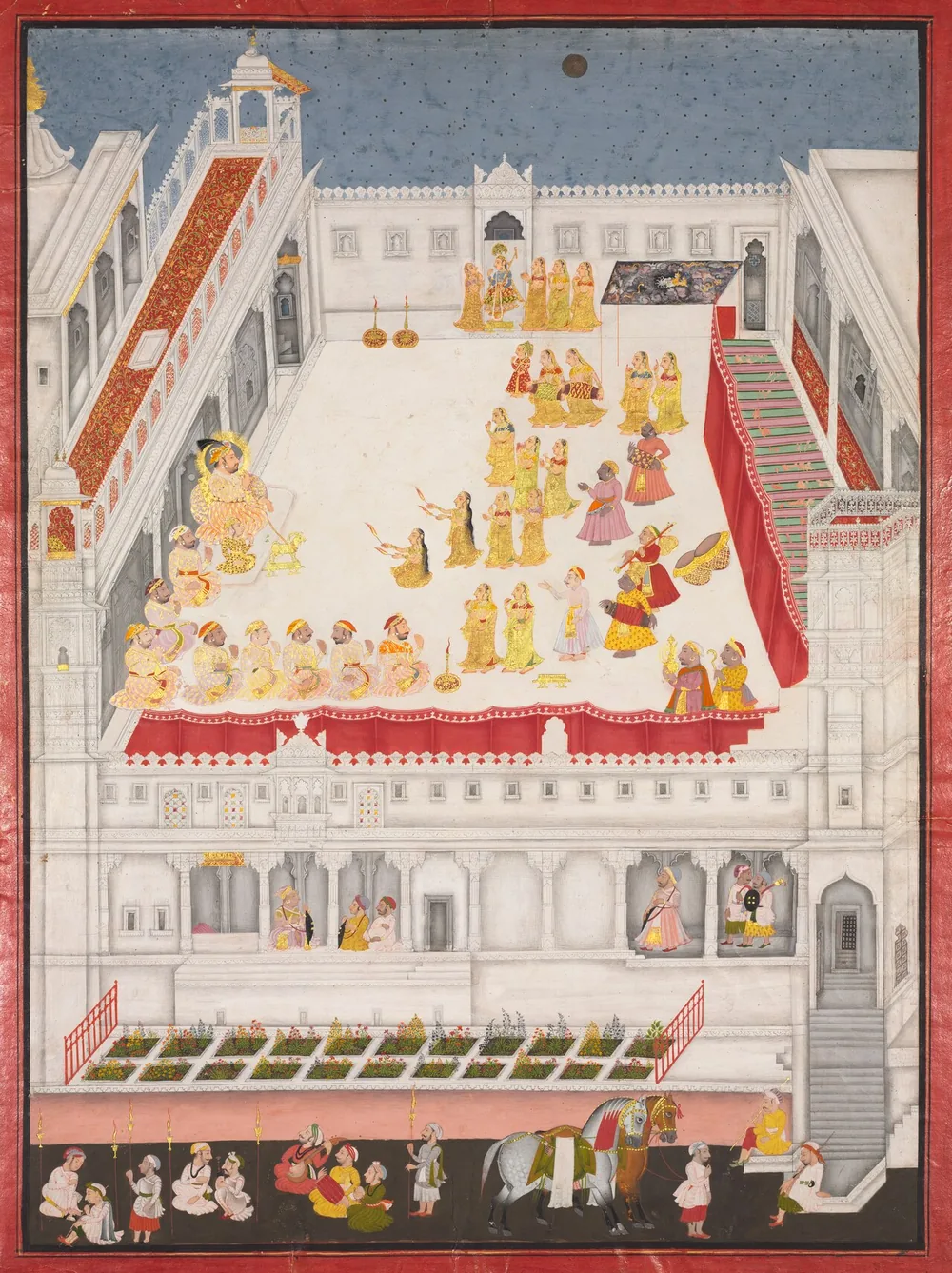 Raslila, Udaipur, 1736
Picture: Jai Ram and Jiva (attributed), Udaipur, 1736, Cleveland Museum of Art, CC0 Nandgaon
Picture: Hemant Shesh, CC BY-SA 4.0 Lathmar Holi, Barsana
Picture: Avis19871, CC BY-SA 4.0
If a picture is yours and the credit is wrong, write to [email protected].
To send this page to someone: